Bring us the one recurring task that keeps slipping through the cracks. We'll map the bottleneck, show a practical improvement, and scope an implementation if it makes sense.
We build working digital tools and process-driven experiences, not just presentations about them. Explore the public examples below to see how we connect steps, decisions, and accountability.
FIELD OPERATIONS
Assign→Check in→Document→Sign off
Code-backed workflow summary, not a screenshot or live dashboard
DC Design Haus · Product development
Bramwell field operations
What we built: A field-service product workflow spanning job assignment, technician status, work evidence, and customer acknowledgment.
Implementation evidence: The private product source includes feature-test scenarios for assignment controls, location check-ins and completion verification. No customer ROI or production screenshot is claimed.
Actual public application capture · November 2026 · opens full size
Founder's published work · Usable application
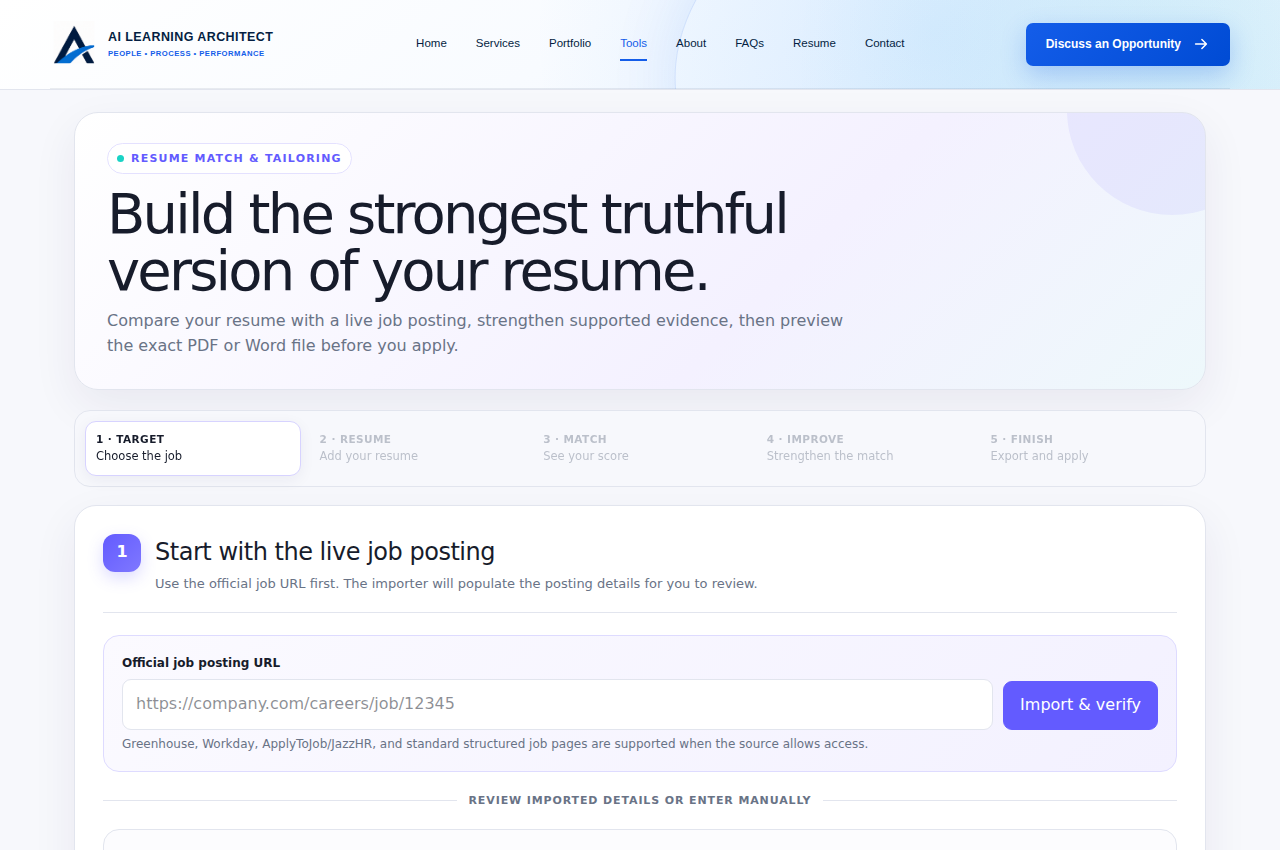
Resume Match & Tailoring
What we can demonstrate: A publicly accessible tool for comparing job requirements with resume evidence, reviewing improvements, and exporting documents.
Why it matters: A multi-step process becomes a guided workflow with checks before completion.
Built as DC Design Haus product development. This is a documented implementation example, not a claim about results achieved for a paying client.
Operational challenge
A field-service workflow must distinguish assigned, in progress, and completed. A change of status alone cannot establish who performed the work or what evidence was collected.
How the software is structured
Assign: Associate a work order with a valid, authorized worker.
Check in: Capture technician arrival and location, when enabled.
Document: Record before-and-after evidence and work history.
Confirm: Require customer sign-off before final completion.
Verification scenarios in source
Reject assignments to inactive workers or workers from a different organization.
Reject completion without required before and after photos.
Reject completion without customer sign-off.
Protect completed work orders against inadvertent reopening.
Evidence basis: Implementation and dedicated Laravel feature-test cases in the private Corden/Bramwell repository, including dispatch integrity, completion evidence, location check-in and customer sign-off tests. These describe checks implemented in source, not independently verified customer outcomes or current production test results.
How this applies to a Business Rescue: We can take the same principle into a smaller workflow, such as a consultation-to-contract handoff: record the agreed next action, name the receiving owner and confirm acceptance before the handoff is considered complete. That is an illustrative approach, not evidence of a problem at any specific brokerage.
Technical case study / 02
Resume Match: make every edit traceable to real evidence.
A published, independently developed application by the DC Design Haus founder. The purpose is to move job applications through one guided workflow while preserving the distinction between existing qualifications, underrepresented evidence and genuine gaps. It is not presented as a paid Business Rescue Room engagement.
Matching a resume to each job posting involves repeated extraction, comparison, rewriting and document preparation. Without a consistent review process, applicants can lose the connection between the employer's stated requirements and the experience their resume actually supports.
How the published application is structured
Source the role: Import an official job posting when supported and review the extracted details, or enter the job description manually.
Establish the evidence: Add a current PDF, Word or text resume; retain that source as the basis for comparison.
Analyze requirements: Separate demonstrated evidence from items needing clearer wording and genuinely unsupported requirements.
Review and recalculate: Edit the working resume, then recompute its match using the same retained job-requirement rubric.
Preview and export: Review the generated PDF or Word file before downloading, with a separate action to clear the current browser session.
Application-level controls
Comparable scoring: The interface describes browser-based scoring and rechecks against a frozen job rubric, rather than silently moving the goalposts during revision.
Evidence boundary: AI wording help is optional and is described as limited to experience already supported by the resume, not invented credentials or results.
Structured editing: The visual and HTML editors provide section, skill, heading and list controls; the public interface says HTML input is sanitized before application.
Document integrity: Preview is required before corresponding downloads; editing the resume or stationery invalidates earlier previews.
Session control: The completion screen explains how to clear current application materials and states that optional AI requests send only text needed for those requests.
Evidence basis: The published five-step application, its documented UI controls and its authentic public-page screenshot. These are observable product-interface statements, not an independent review of its private source code, a penetration test, or a guarantee of ATS compatibility.
How this applies to a Business Rescue: The same implementation pattern can simplify other review-heavy processes: verify an incoming source, establish evidence, compare against explicit criteria, require human review, and release an approved output. The application demonstrates the approach; it does not establish savings or results for an external client.
Privacy note: The public application states that application materials are not persistently stored on its server and that optional AI requests use relevant submitted text. These are published product disclosures, not independently audited storage or privacy guarantees.
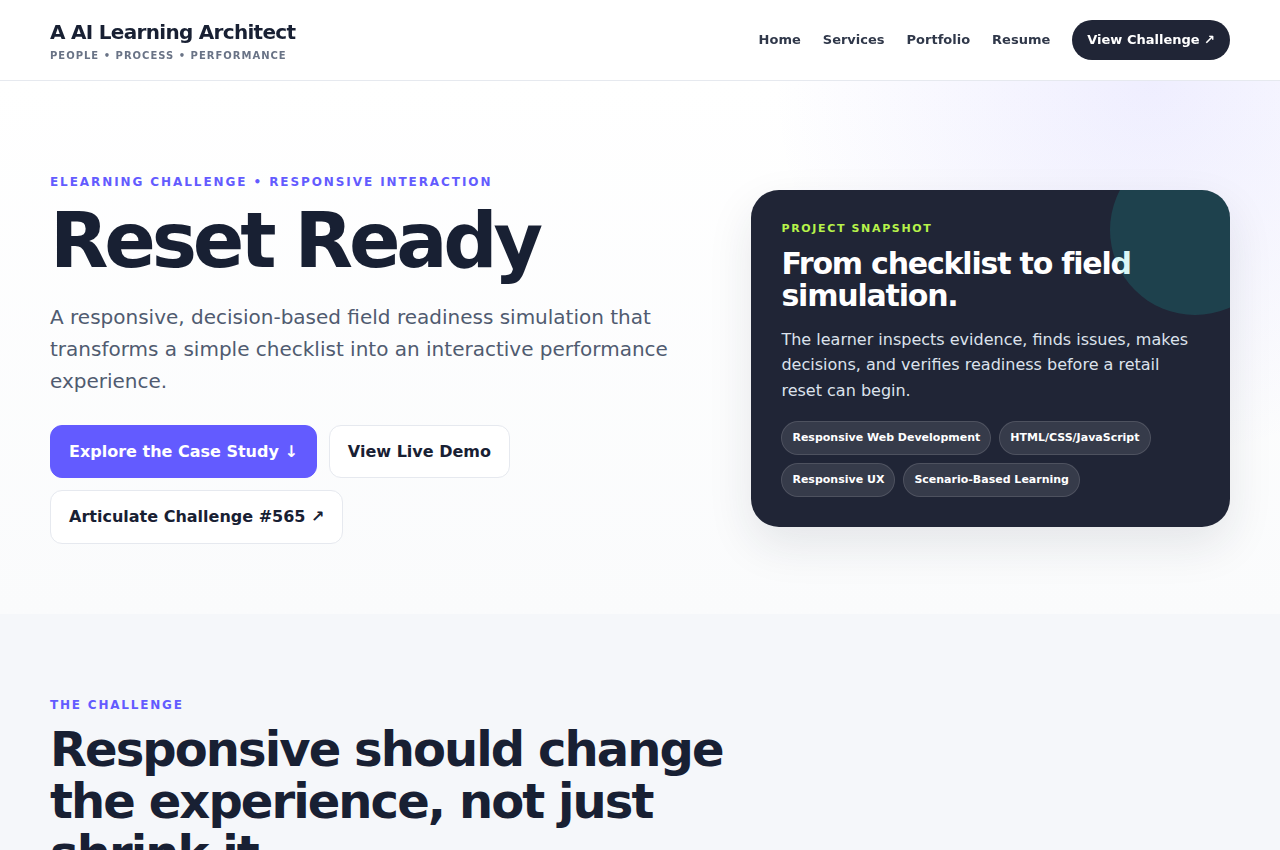
These are DC Design Haus product-development and founder-portfolio examples, not paid Business Rescue Room engagements or verified customer ROI. Resume Match and Reset Ready images are verified anonymous captures of their public pages; the Bramwell diagram summarizes privately developed workflow logic and is not an application screenshot. Product descriptions and controls are not substitutes for independent security audits or verified customer outcomes. No real customer records are shown.
02 / A workflow, not a sales pitch
See the handoff that matters.
Illustrative example only. No customer outcome or performance data is claimed.
Before / Fragmented
New inquiry arrives
↓
Sits in shared inbox
↓
Follow-up ownership is unclear
Proposed after / Accountable
Capture inquiry consistently
↓
Assign a responsible person
↓
Track response and next action
03 / A defined engagement
One workflow. Four clear steps.
01
Diagnose
Understand what happens today.
02
Demonstrate
Show a practical before-and-after.
03
Implement
Configure an agreed change within a written scope.
04
Measure
Track an outcome the customer actually values.
04 / Proposed pilot engagement
Less software. More progress.
Business Workflow Rescue: a short discovery conversation and, if feasible, a fixed-scope implementation proposal. Pricing and delivery depend on verified requirements. The first conversation takes up to 15 minutes. Bring one example and tell us who handles the next step.


 FIELD OPERATIONS